
Fleet Pickup and Delivery Planning
| Lines of Code | 3393 |
| Technical name | viin_fleet_stock |
| License | OPL-1 |
| Website | https://viindoo.com/apps/modules/17.0/viin_fleet_stock |
| Read description for | v 10.0 v 11.0 v 12.0 v 13.0 v 14.0 v 15.0 v 16.0 v 18.0 |
| Required Apps | Invoicing (account) Discuss (mail) Employees (hr) Inventory (stock) Fleet (fleet) |
| Included Dependencies | Fleet Drivers Management Fleet Booking & Trip Management Fleet Loading Capacity Employee Documents Viindoo Unified Routing Framework Fleet Operations Product Dimensions QR Code Mixin Viindoo Base Advanced HR Management Viin Fleet API Request Logger Stock Transfer Addresses Partner Working Calendar |

Which truck is carrying which transfer
Trips that carry stock transfers: loads per vehicle, chain-linked shipments grouped into one carry, and splitting a load across trips.
Fleet Pickup and Delivery Planning (technical name viin_fleet_stock) is an Odoo 17.0 app for Odoo Community and Odoo Enterprise and Viindoo Cloud, built for dispatcher, warehouse, customer service, fleet manager.

At a Glance
The facts of Fleet Pickup and Delivery Planning, version 1.0.7, in one place. Published by Viindoo.
How It Works
Three screens.
One carry
The transfers that travel together, with their combined weight and volume.
The carries in the system
One row per leg, per vehicle and trip.

And the trip that carries them
The route, the vehicle and the load it is taking.

What You Get
Trip loads: which transfers a vehicle is carrying
Carries: chain-linked transfers grouped as one leg, and only genuinely linked ones
Combined weight and volume per leg
Split a load across trips when it does not fit
Assign a vehicle from the transfer, and shipments from the trip
Waypoints and route data shared with fleet planning
More Screens
Everything below was taken on a database seeded with real business data, on this series - not a mock-up and not a screenshot from an older version.
A trip
What This App Does Not Do
Read this before you buy. Everything below is something the app deliberately leaves to another app or to you.
Grouping unrelated shipments is refused, deliberately - a carry is one movement, not a bag.
Routing and waypoints are Fleet Planning; this is what the vehicle is carrying.
Cost belongs to the fleet accounting modules.
Unmeasured products contribute nothing, which is visible rather than hidden.
Works Well With
Apps from the same stack, built to fit this one:
Who Should Use Fleet Pickup and Delivery Planning?
Dispatcher
Loads a trip from the transfers waiting, with weight in view.
Warehouse
Knows which vehicle a shipment left on.
Customer service
Can answer where the goods are.
Fleet manager
Sees the vehicle's day as loads rather than as a list of addresses.
Frequently Asked Questions
What does Fleet Pickup and Delivery Planning do?
Trips that carry stock transfers: loads per vehicle, chain-linked shipments grouped into one carry, and splitting a load across trips.
What does Fleet Pickup and Delivery Planning not do?
Only genuinely linked transfers form a carry. Grouping unrelated shipments is refused, deliberately - a carry is one movement, not a bag. It does not optimise routes. Routing and waypoints are Fleet Planning; this is what the vehicle is carrying. It does not price freight. Cost belongs to the fleet accounting modules. Weight and volume come from the products. Unmeasured products contribute nothing, which is visible rather than hidden.
Who is Fleet Pickup and Delivery Planning for?
Dispatcher: Loads a trip from the transfers waiting, with weight in view. Warehouse: Knows which vehicle a shipment left on. Customer service: Can answer where the goods are. Fleet manager: Sees the vehicle's day as loads rather than as a list of addresses.
Which Odoo version and editions does it support?
Odoo 17.0 - Odoo Community, Odoo Enterprise, Viindoo Cloud. Upgrades to a newer Odoo series are a separate purchase for that series.
What does it depend on?
It installs on top of: stock, stock_delivery, stock_picking_batch, viin_transfer_address, viin_fleet_loading_capacity, to_product_dimensions, viin_fleet_planning, base_geolocalize. Odoo installs them with it.
How do I set it up?
Three screens.
What works well with it?
Fleet Planning (viin_fleet_planning): The trips, routes and waypoints. Logistics (viin_logistics): The wider freight layer. Fleet Booking (viin_fleet_booking): Who else wants the vehicle that day.
Can I try it before buying?
Yes - the Live Preview button at the top of this page opens the module's own screen on a working database.
How do I get support?
Write to apps.support@viindoo.com with your Odoo version and the technical name viin_fleet_stock; pre-sales questions go to sales@viindoo.com.
See Fleet Pickup and Delivery Planning in Action
Which truck is carrying which transfer
Need help with Fleet Pickup and Delivery Planning?
For questions, implementation support, or consulting services, contact Viindoo.
Pre-Sales & Partnership
sales@viindoo.comWhen contacting us, please include:
- Odoo/Viindoo version (Odoo CE / Viindoo Editions).
- Number of users and business scope.
- Other modules currently in use.
Technical Support
apps.support@viindoo.comFor faster troubleshooting, please provide:
- Order number or app reference.
- Odoo/Viindoo version & edition.
- Steps to reproduce the issue.
- Screenshots/logs if available.
Upgrades to a newer Odoo series are a separate purchase for that series.
Technical Requirement
Changes log
1.0.7 - Latest on the 17.0 line
- A carry refuses shipments that are not chain-linked to each other.
- Loads can be split across trips.
Fleet Pickup and Delivery Planning
Note
Extends viin_fleet_loading_capacity - see its documentation.
Note
Extends viin_fleet_planning - see its documentation.
This guide shows warehouse and logistics staff how to assign vehicles and vehicle trips to stock transfers (pickings), batch deliveries onto one trip, and split an oversized shipment across several vehicles.
Installation
- Go to Apps.
- Search for Fleet Operations (the Fleet trip-planning app) and install it if it is not already installed. Also make sure Inventory is installed.
- Search for Fleet Pickup and Delivery Planning (technical name viin_fleet_stock). If Inventory and Fleet Operations are both already installed, this module installs itself automatically; otherwise click Install.
- Two small utility apps come along automatically: Fleet Loading Capacity (Volume & Payload) (adds Warning/Max Volume and Payload to vehicles) and Product Dimensions (adds volume and weight information to products).
Configuration
Before planning shipments, prepare the following master data:
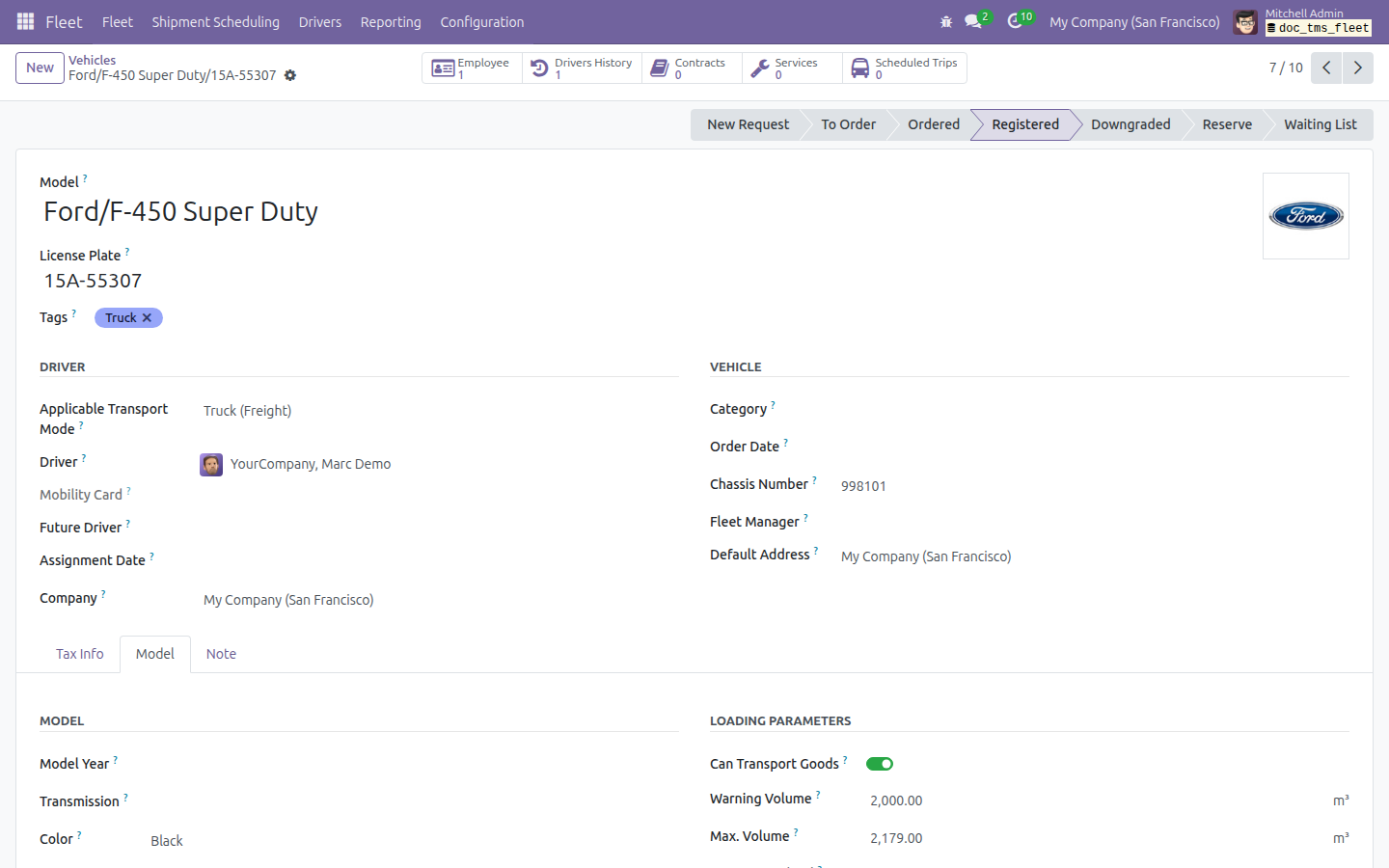
- Vehicles - open Fleet > Vehicles, choose a vehicle, and open the Model tab. Under Loading Parameters, turn on Can Transport Goods and set the Warning Volume, Max. Volume, Warning Payload, and Max. Payload for the vehicle. Under Receipt & Delivery, the Domain field restricts which stock transfers this vehicle is allowed to carry - leave it matching all records unless you need to narrow eligibility (for example, to a specific warehouse or operation type).
- Delivery addresses - every shipment you want to schedule must have both a pickup and a delivery address filled in (Receive Address / Delivery Address on the transfer). A shipment without a delivery address cannot be assigned to a vehicle or a trip.
- Access rights - the scheduling screens are available to users in the Fleet Logistics role; the direct picking actions (Assign Trip, Add Shipments) are available to users in the Fleet User role. Ask your administrator to grant one of these roles if the menus below are not visible to you.
Usage
Schedule today's ready shipments from a kanban board
Use this when you want to see every shipment ready to go out today and drag each one onto the vehicle (or trip) that will carry it.
- Open Fleet > Shipment Scheduling (also reachable from Inventory > Operations > Transport Planning).
- Choose an Assignment Mode: Vehicle groups the board by vehicle, Trip groups it by vehicle trip.
- Set the Date - only pickups and deliveries scheduled on that date are shown.
- Click Start Planning.
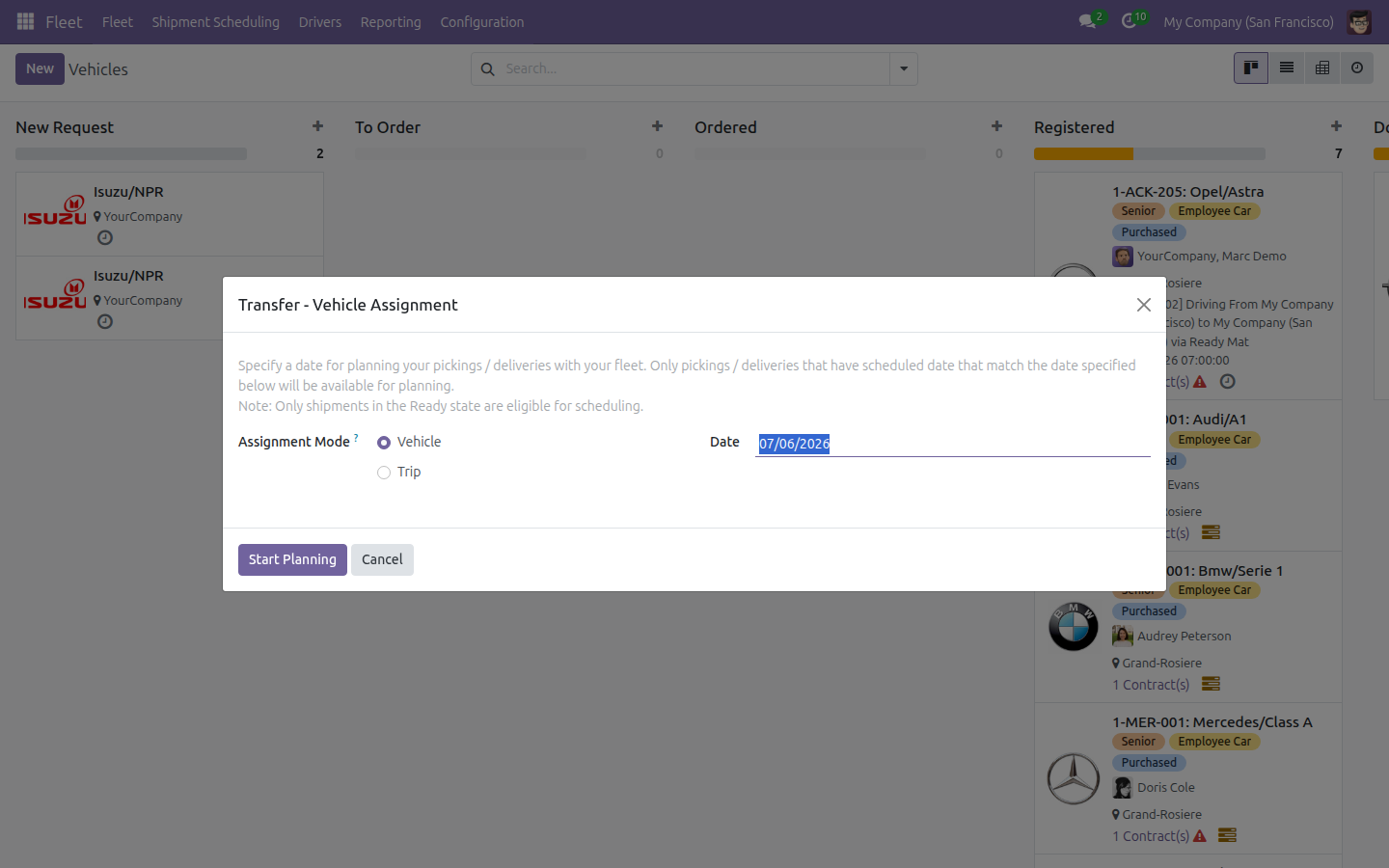
A kanban board opens with every Ready shipment for that date in an unassigned column, plus one column per eligible vehicle (or trip).
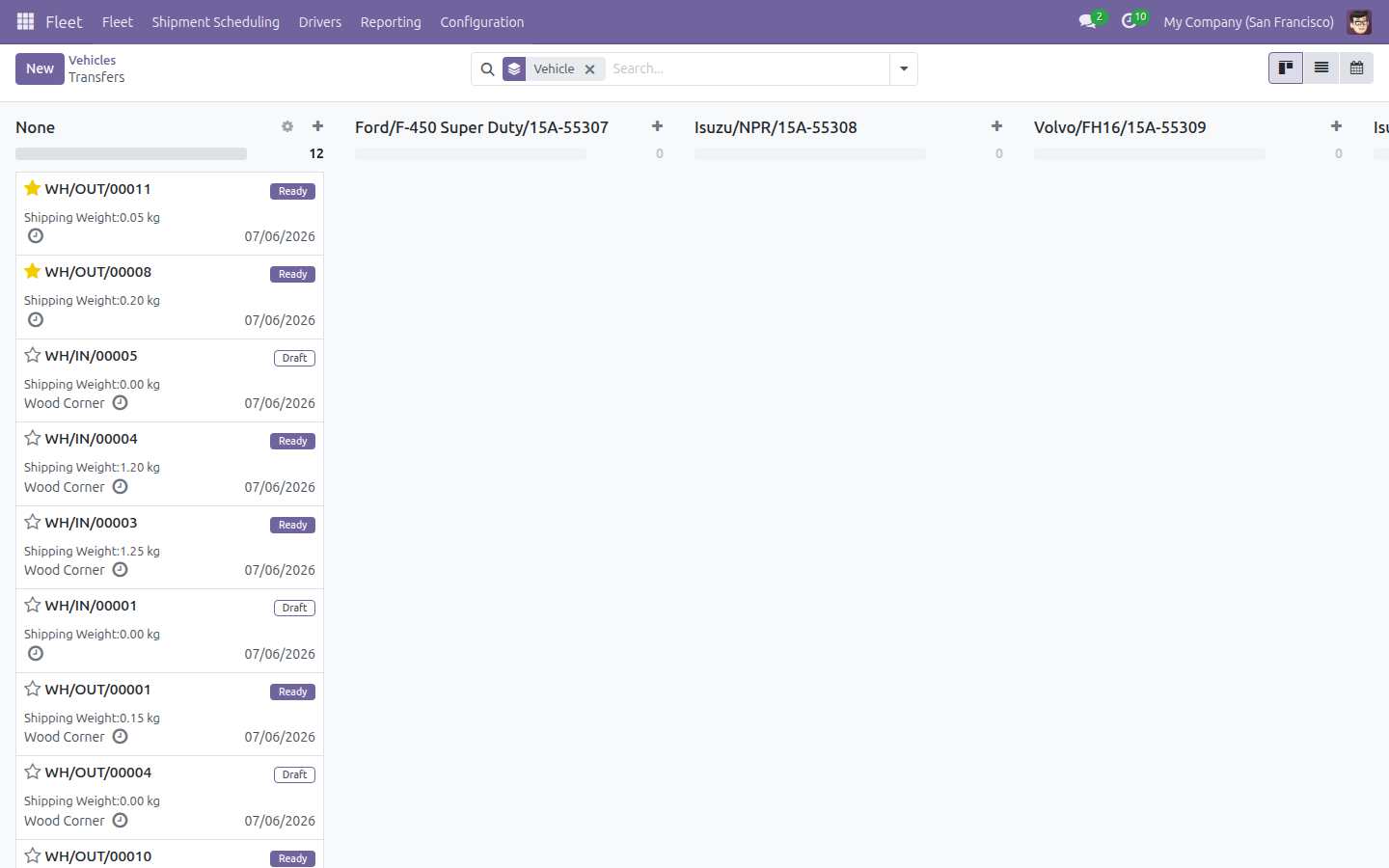
Drag a shipment card from the unassigned column onto the vehicle (or trip) column that should carry it. If you prefer not to drag and drop, you can reach the same result by opening the shipment directly and filling in the Vehicle field yourself, under the Fleet section of the Additional Info tab:
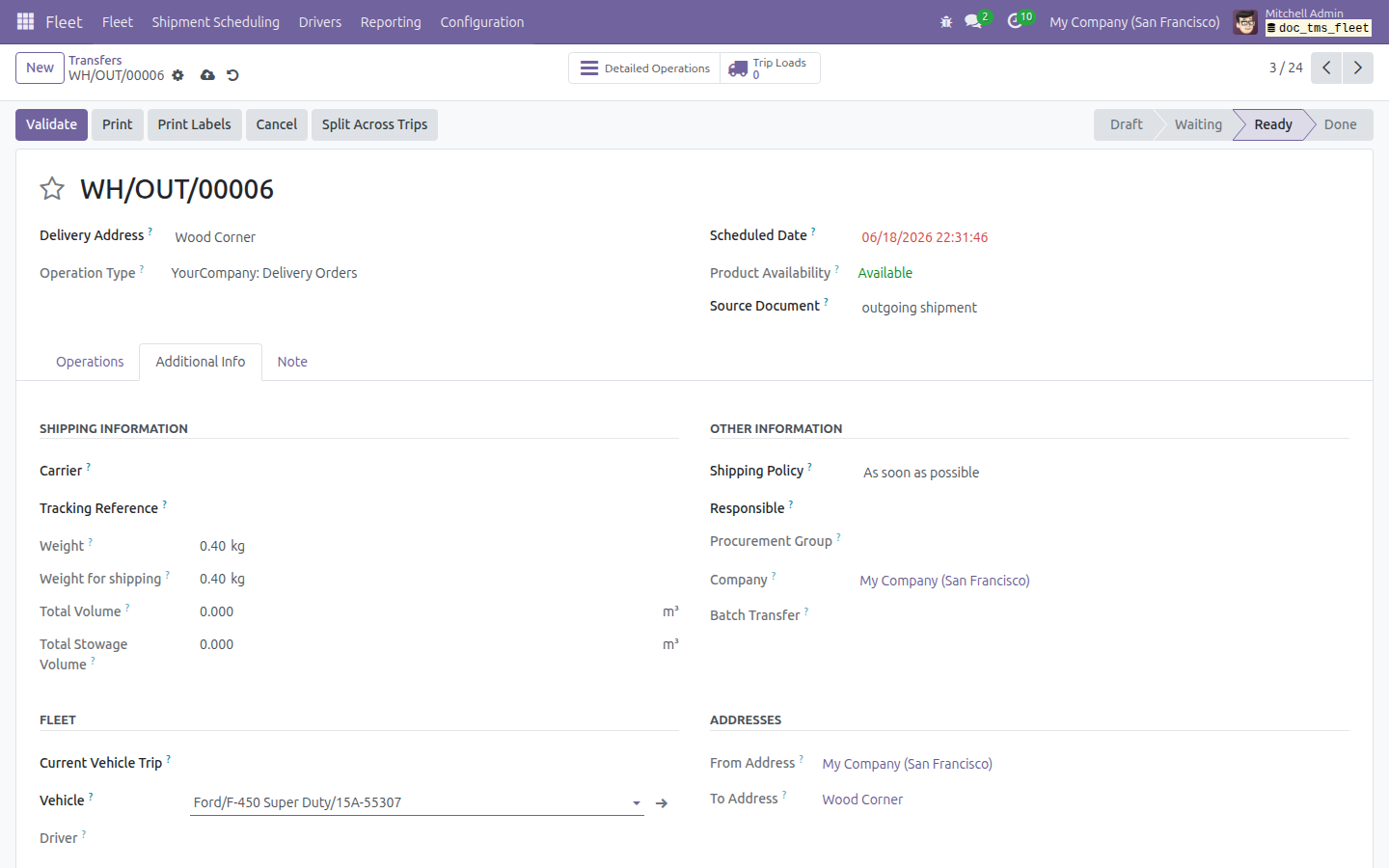
Once saved, the shipment's Vehicle field shows the vehicle you chose, and the transfer now matches the Vehicle Assigned filter in the Transfers list.
Assign one shipment directly to an existing vehicle trip
Use this when a vehicle trip already exists (for example, created from Fleet Operations > Trips) and you want to attach one ready shipment to it without leaving the shipment's form.
- Open Inventory > Operations > Transfers and open the ready shipment.
- Click the Action (gear) icon next to the breadcrumb and choose Assign Trip.
- In the Assign Trip window, select the Vehicle Trip and click Add.
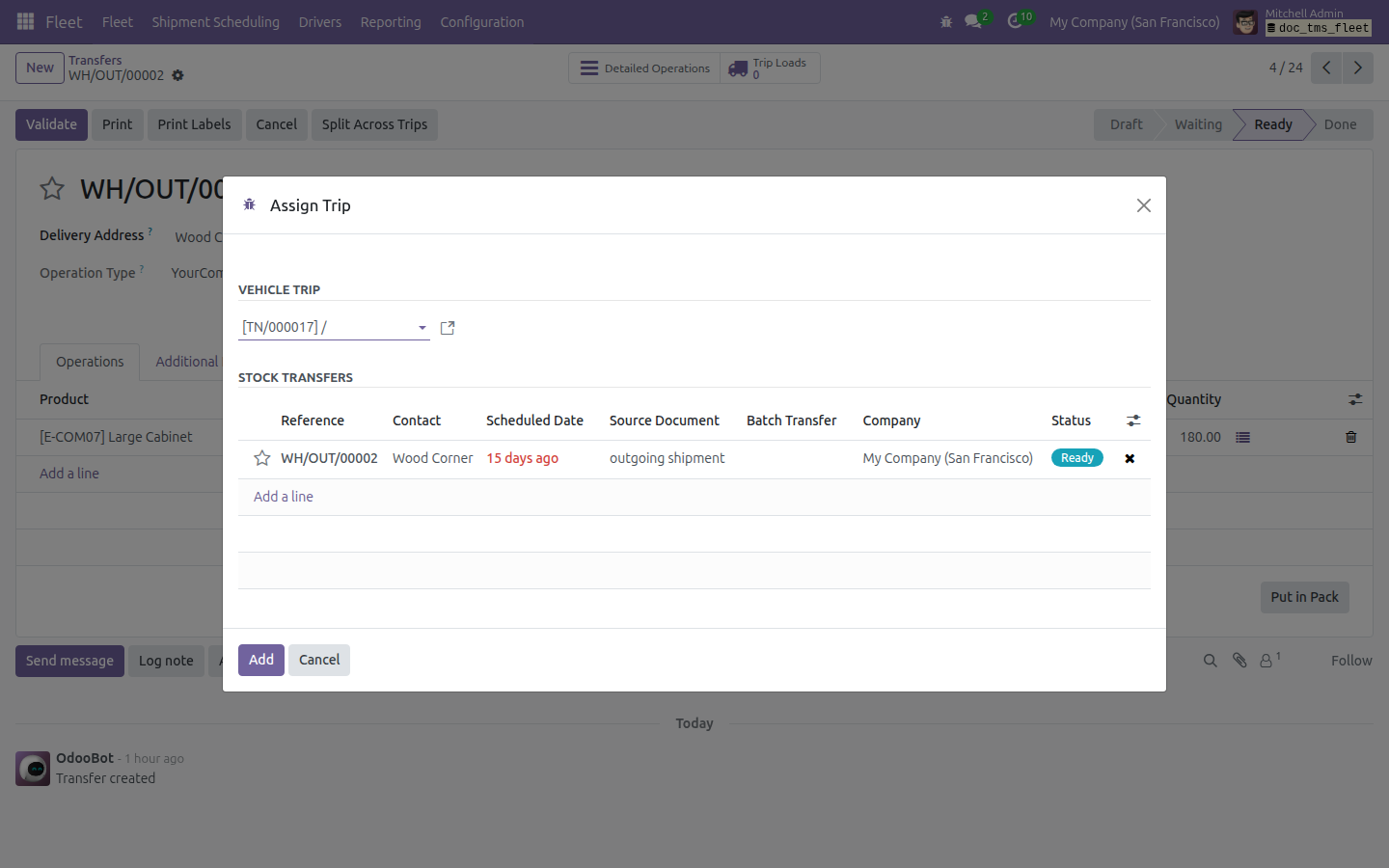
You can reach the same outcome by opening the shipment's Additional Info tab and filling in the Current Vehicle Trip field yourself; the Vehicle and Driver fields fill in automatically from the trip you picked:
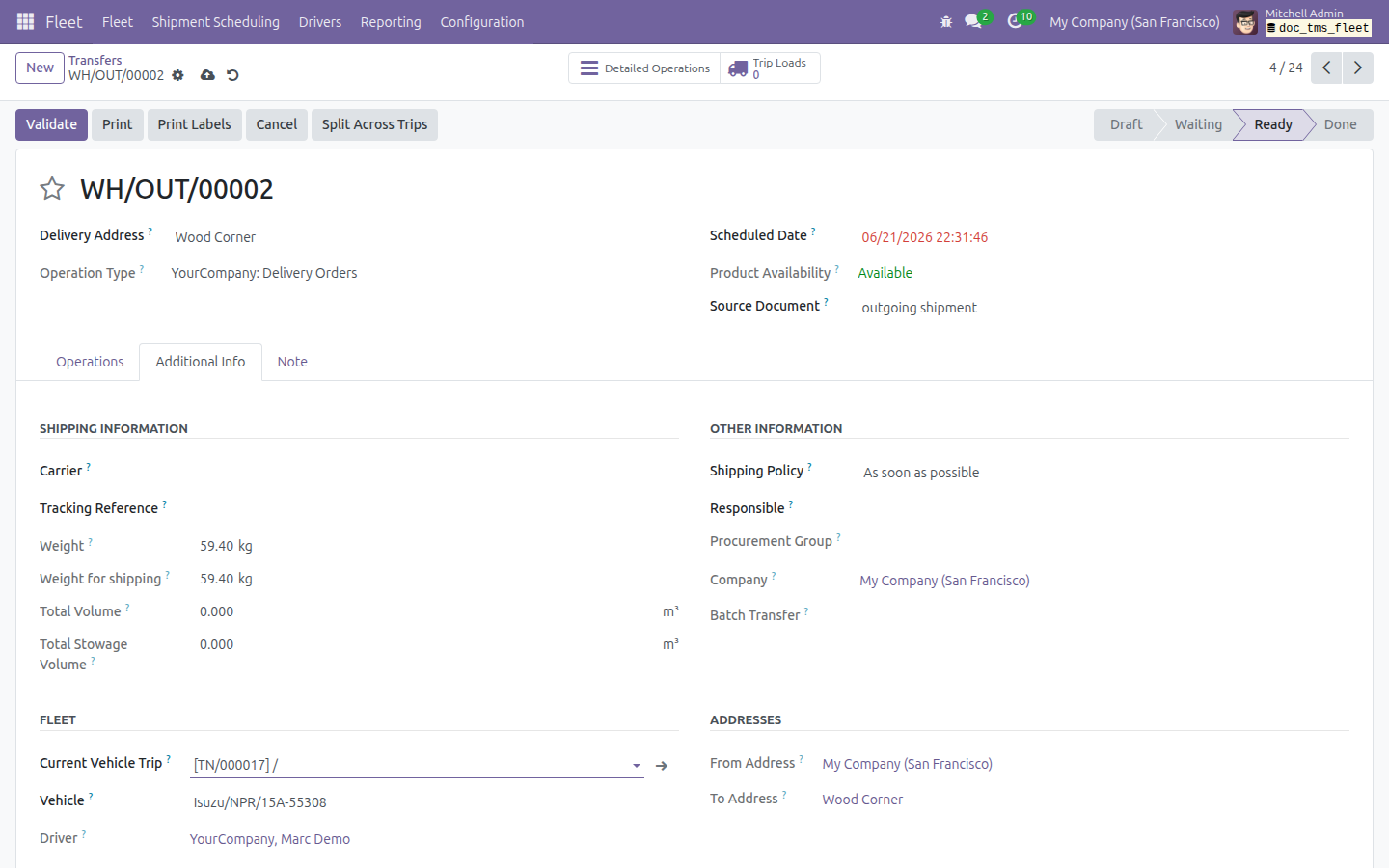
After saving, the shipment's Fleet section shows the Current Vehicle Trip, the mirrored Vehicle, and the mirrored Driver - all without leaving the shipment.
Bulk-add several shipments to one trip
Use this when you have an open vehicle trip and want to load several ready shipments onto it in one go, then hand the driver a printed list.
- Open Fleet Operations > Trips and open the trip.
- Click the Add Shipments button in the header.
- In the Add Shipments window, add one or more entries under Transfers, then click Add.
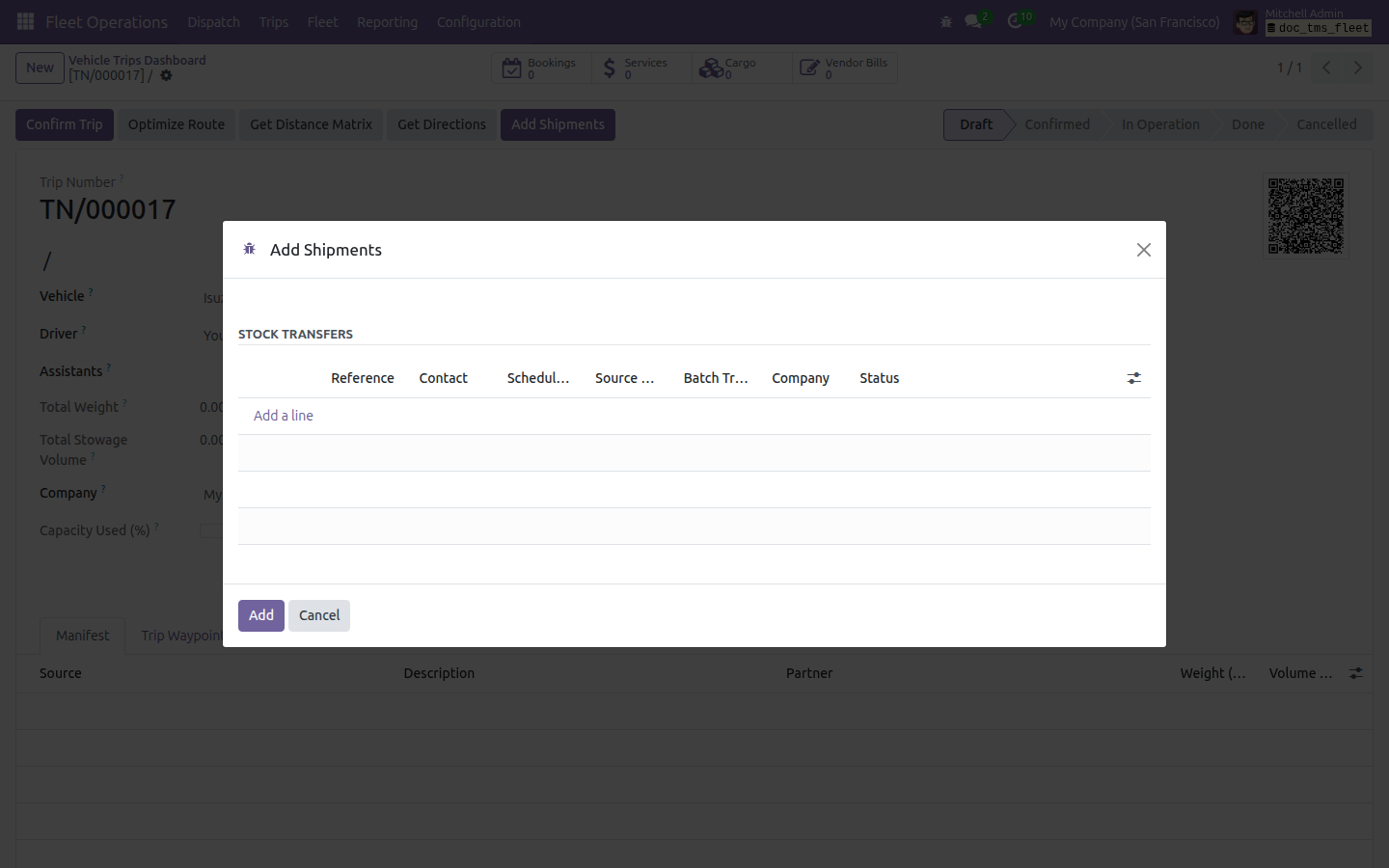
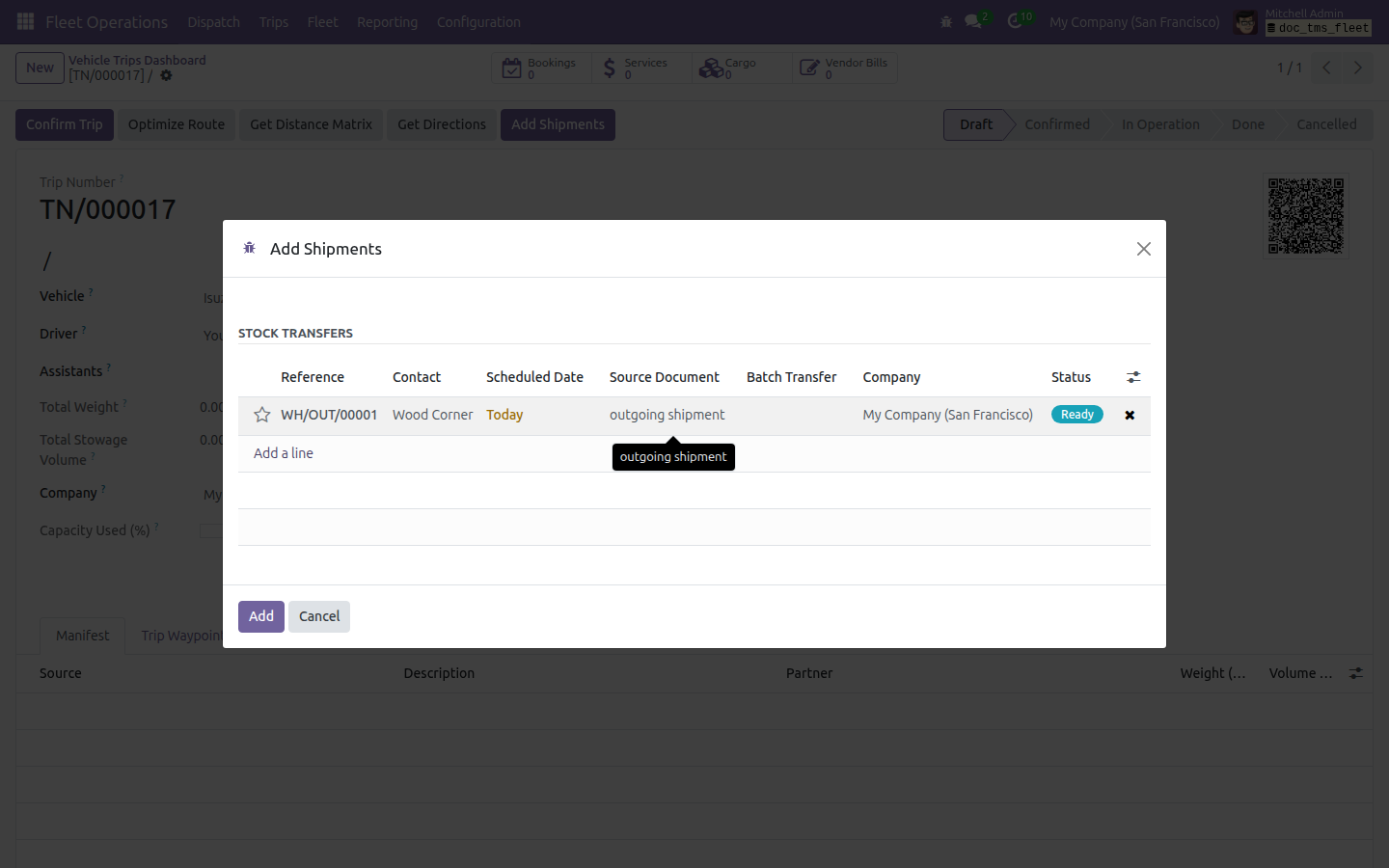
Once confirmed, every shipment you added appears on the trip's Transfers tab, and a matching line appears on the Loads tab. From there you can print the trip's Print Transfers report - a driver-ready handout listing every shipment at its waypoint.
Split one oversized shipment across several vehicle trips
Use this when a single shipment's demand is more than any one vehicle trip can carry, so you need to divide it between two (or more) trips.
Open the shipment and click Split Across Trips in the header.
In the Split Across Trips window, add one allocation line per trip: choose the Trip and enter a Quantity below the Remaining Capacity shown for that trip. Repeat until Allocated Total equals Demand.
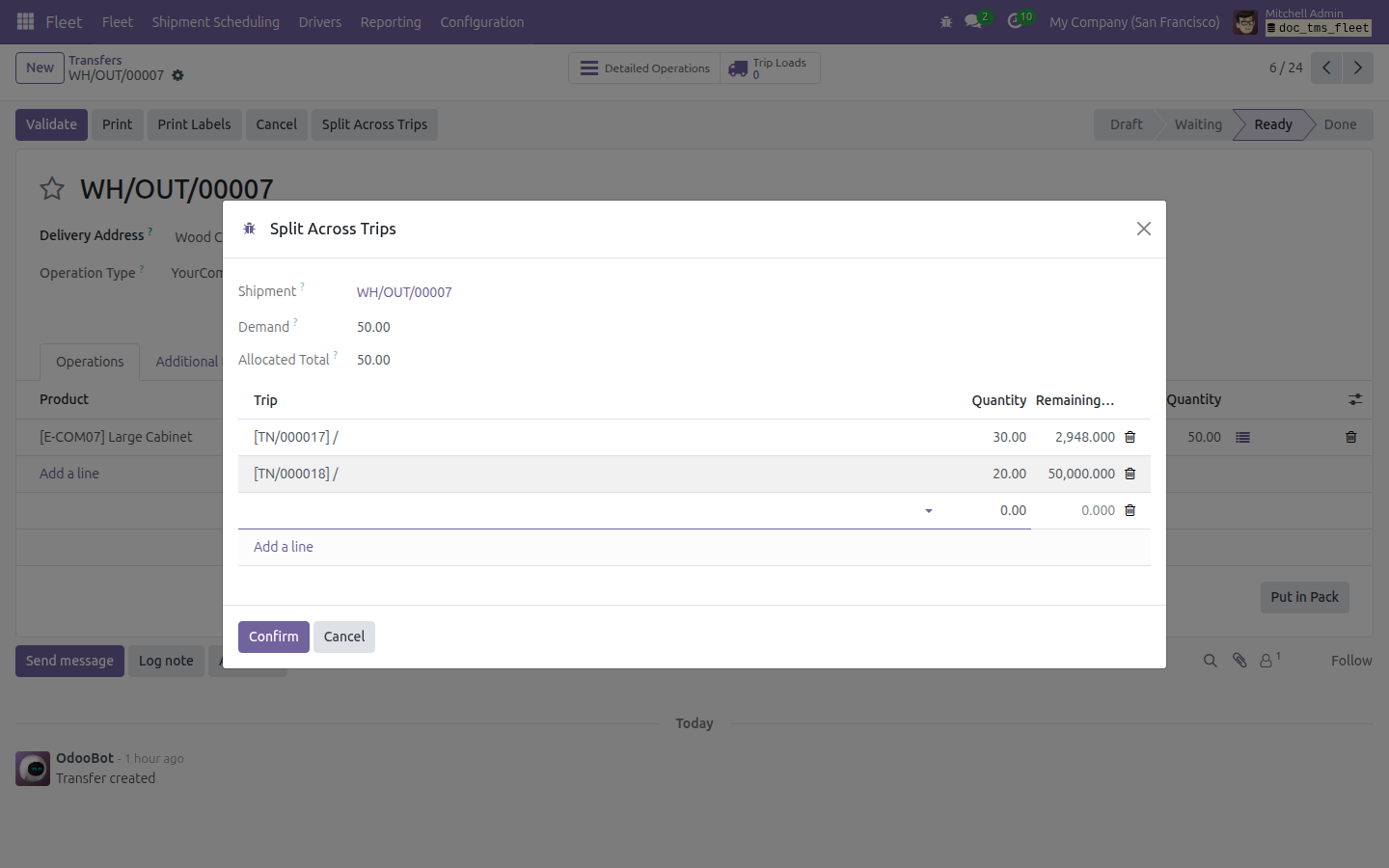
Click Confirm.
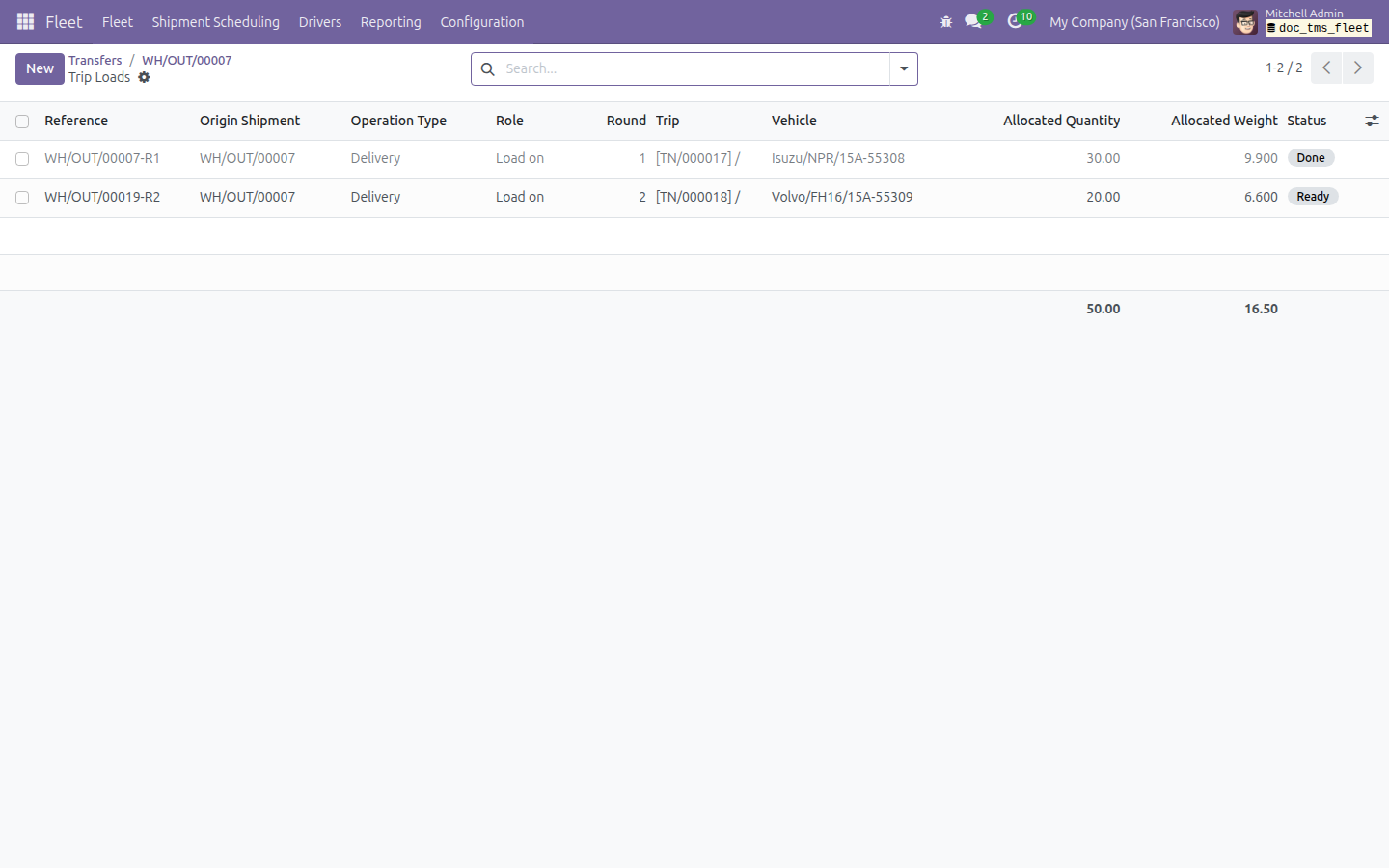
The shipment is carved into one load per trip, and the list of the newly created Trip Loads opens automatically - each load shows the allocated quantity and weight for its trip. No manual backorder step is needed.
Link an entire delivery batch to one vehicle trip
Use this when a batch transfer already groups several shipments from the same wave, and you want the whole wave dispatched under a single vehicle trip.
- Open Inventory > Operations > Transfers > Batch Transfers and open the batch.
- Fill in the Fleet Trip field and click Save.
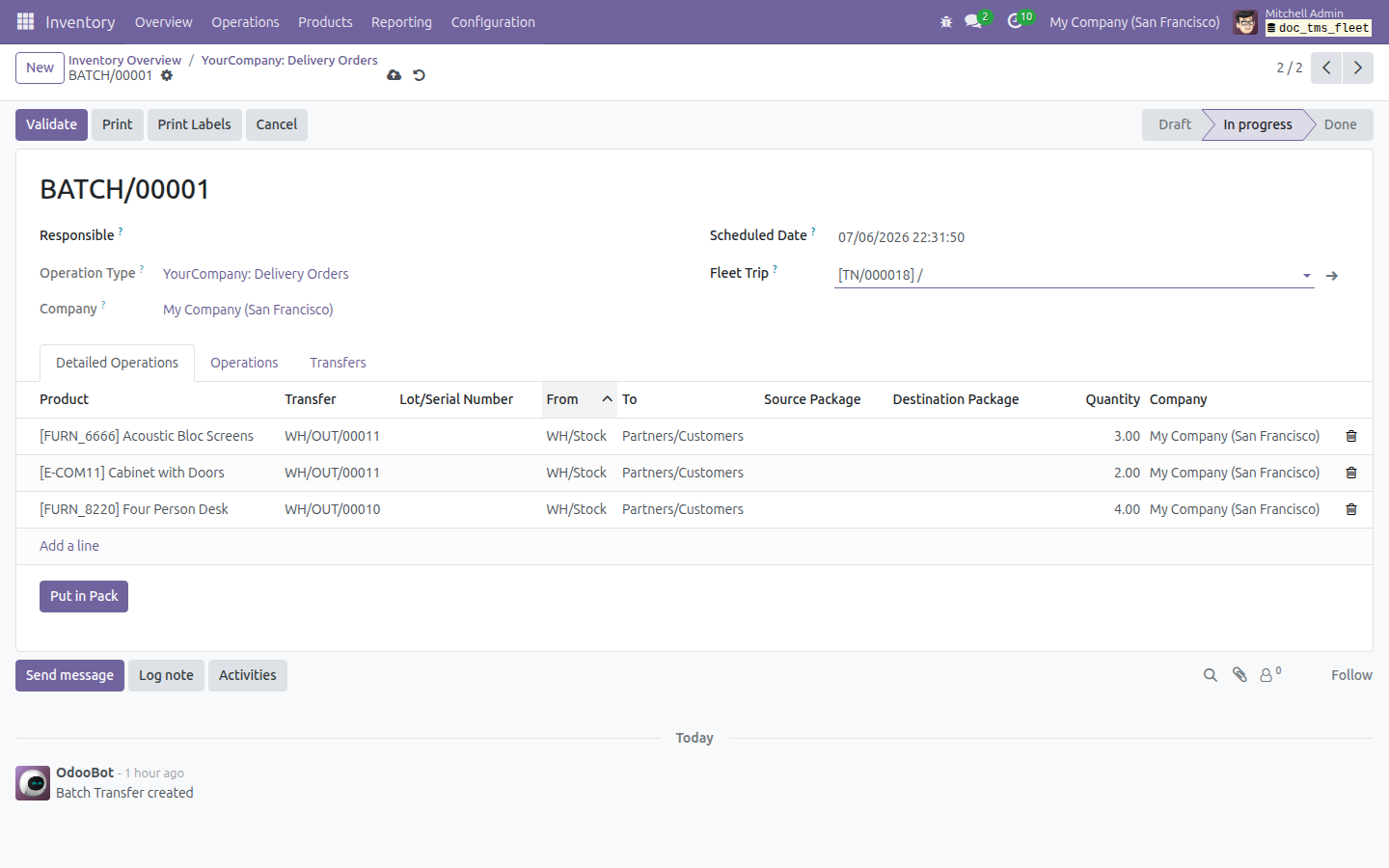
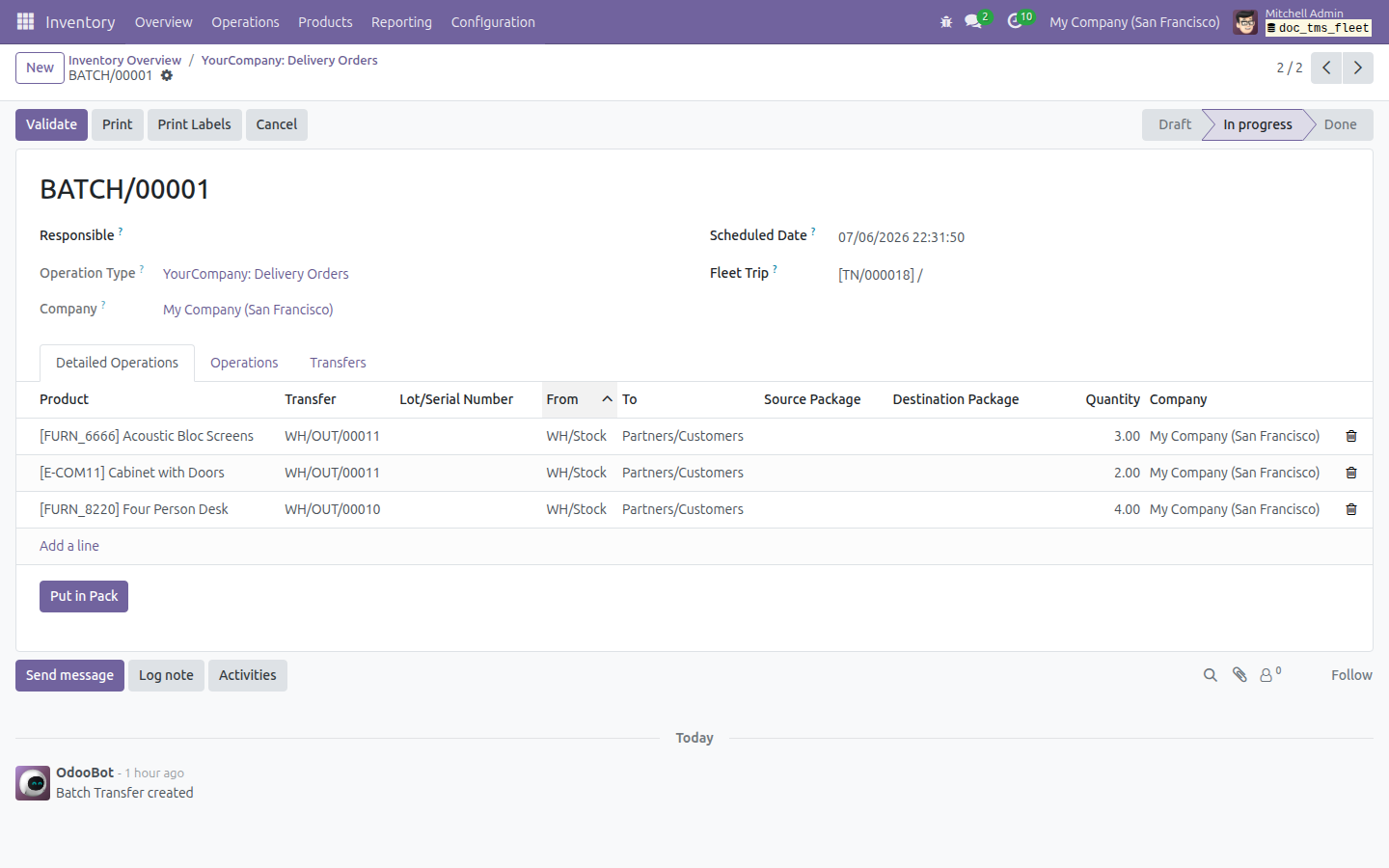
The batch now shows the Fleet Trip you chose, so every shipment in the batch is coordinated under that one trip for dispatch.
Restrict which shipments a vehicle can carry
Every vehicle has a Domain filter (Fleet > Vehicles, Model tab, Receipt & Delivery section) that controls which stock transfers it is allowed to carry. By default it matches all records; narrow it if, for example, a vehicle should only ever carry transfers from one warehouse. This same filter feeds the Shipment Scheduling board and the vehicle eligibility check used when assigning a shipment.
Troubleshooting
"The shipment did not have delivery address specified" when assigning a vehicle or trip. The shipment is missing a Delivery Address (or, for an internal transfer, a proper destination). Open the shipment, fill in the address, save, then retry the assignment.
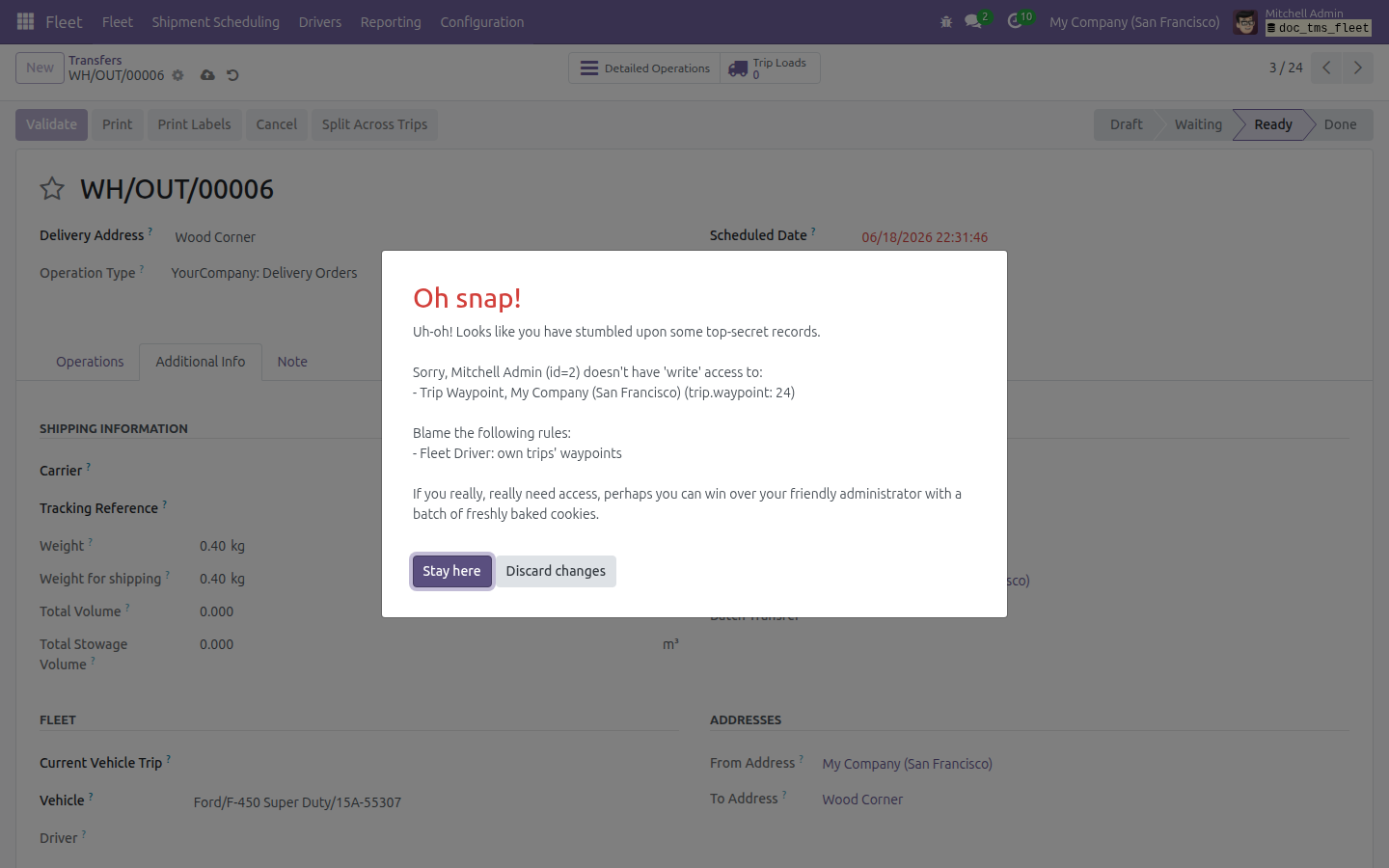
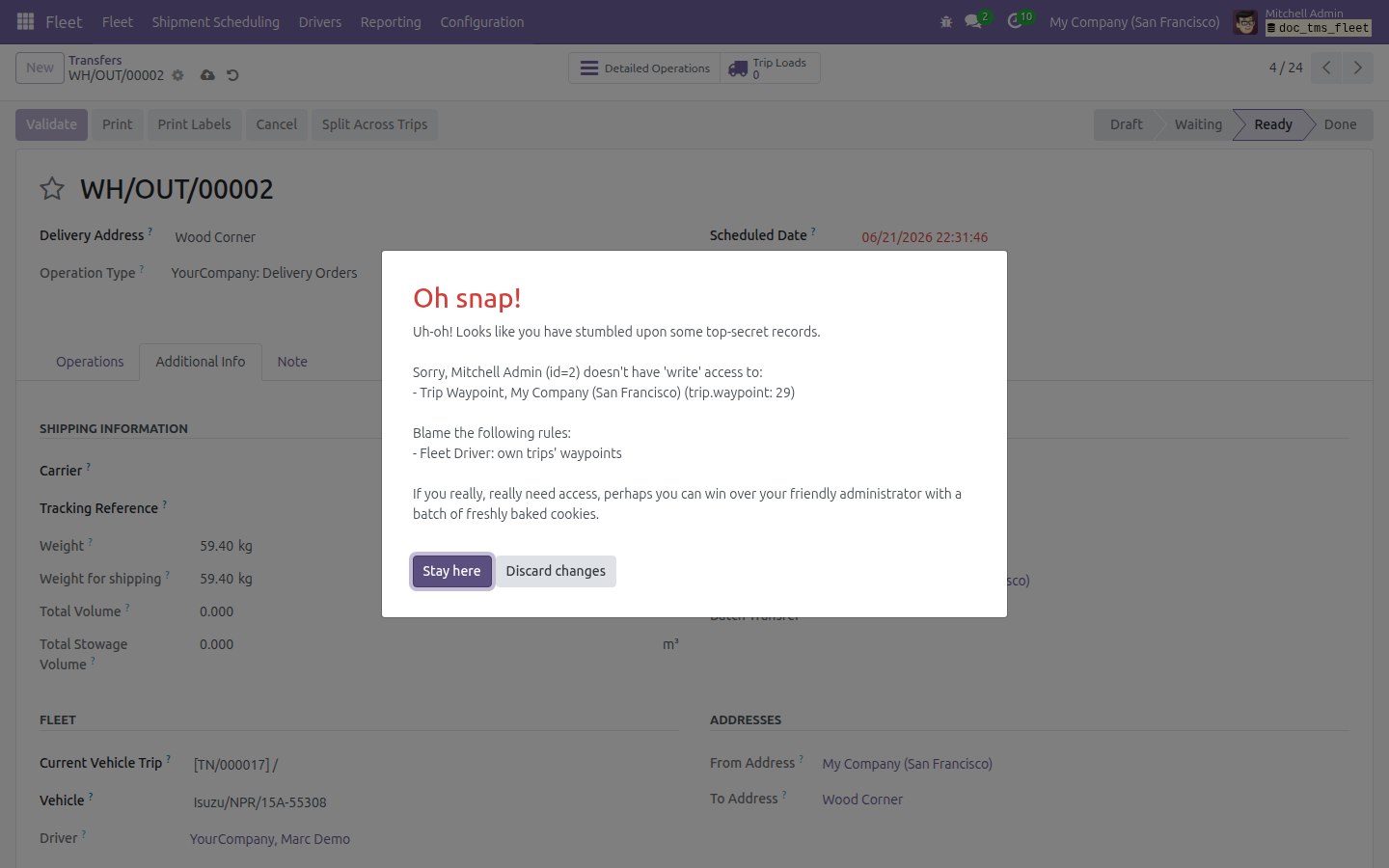
A message says you don't have write access to a "Trip Waypoint" record when you assign a shipment to a vehicle or trip for the first time. This can happen when the automatic route-point creation for a brand-new trip needs a permission your user does not have. Two things help: first, opening the shipment and filling in the Vehicle or Current Vehicle Trip field directly (instead of dragging the card on the kanban board, or using the Assign Trip / Add Shipments wizard) still saves the assignment correctly even if this message appears - check the shipment's Fleet section afterwards to confirm. If the message keeps appearing, ask your administrator to review your user's access rights for fleet trip waypoints.
The Transfers tab on a vehicle trip does not display. Refresh the page. If it still does not show, use the trip's Loads tab, or the shipment's own Trip Loads smart button, to confirm which shipments are linked to the trip.
A vehicle does not appear as a column when scheduling shipments. Check that the vehicle has Can Transport Goods turned on (Fleet > Vehicles, Model tab) and that its Domain does not exclude the shipment you are trying to assign.
FAQ
Can I assign a shipment to a vehicle without creating a trip first? Yes - use Fleet > Shipment Scheduling in Vehicle mode, or fill in the Vehicle field directly on the shipment. A trip is only required when you want to group several shipments (and a driver) together, or print a driver handout.
What happens to the shipment's Vehicle and Driver fields once it is linked to a trip? They are filled in automatically from the trip and stay in sync with it - you do not need to set them separately.
Can one vehicle trip carry pickups and deliveries at the same time? Yes - a trip can combine supplier pickups and customer deliveries; each shipment keeps its own pickup and delivery waypoints on the trip's route.
Does splitting a shipment across trips require a manual backorder? No - confirming the Split Across Trips window creates one load per trip automatically; no manual backorder step is required.
Instruction video
This software and associated files (the "Software") may only be used (executed, modified, executed after modifications) if you have purchased a valid license from the authors, typically via Odoo Apps, or if you have received a written agreement from the authors of the Software (see the COPYRIGHT file).
You may develop Odoo modules that use the Software as a library (typically by depending on it, importing it and using its resources), but without copying any source code or material from the Software. You may distribute those modules under the license of your choice, provided that this license is compatible with the terms of the Odoo Proprietary License (For example: LGPL, MIT, or proprietary licenses similar to this one).
It is forbidden to publish, distribute, sublicense, or sell copies of the Software or modified copies of the Software.
The above copyright notice and this permission notice must be included in all copies or substantial portions of the Software.
THE SOFTWARE IS PROVIDED "AS IS", WITHOUT WARRANTY OF ANY KIND, EXPRESS OR IMPLIED, INCLUDING BUT NOT LIMITED TO THE WARRANTIES OF MERCHANTABILITY, FITNESS FOR A PARTICULAR PURPOSE AND NONINFRINGEMENT. IN NO EVENT SHALL THE AUTHORS OR COPYRIGHT HOLDERS BE LIABLE FOR ANY CLAIM, DAMAGES OR OTHER LIABILITY, WHETHER IN AN ACTION OF CONTRACT, TORT OR OTHERWISE, ARISING FROM, OUT OF OR IN CONNECTION WITH THE SOFTWARE OR THE USE OR OTHER DEALINGS IN THE SOFTWARE.