
OmniApproval™ - Stock Approvals
by Viindoo
| Lines of Code | 2417 |
| Technical name | viin_approval_stock |
| License | OPL-1 |
| Website | https://viindoo.com/apps/modules/19.0/viin_approval_stock |
| Read description for | v 17.0 v 18.0 |
| Required Apps | Discuss (mail) Inventory (stock) Employees (hr) |
| Included Dependencies | Viindoo Base OmniApproval™: One platform. Every approval. Advanced HR Management Safe IR Metadata Proxies |
| Extensions | OmniApproval™ - MRP Approvals OmniApproval™ - Purchase Stock Approvals Bridge |

Release the shipment when somebody has signed for it
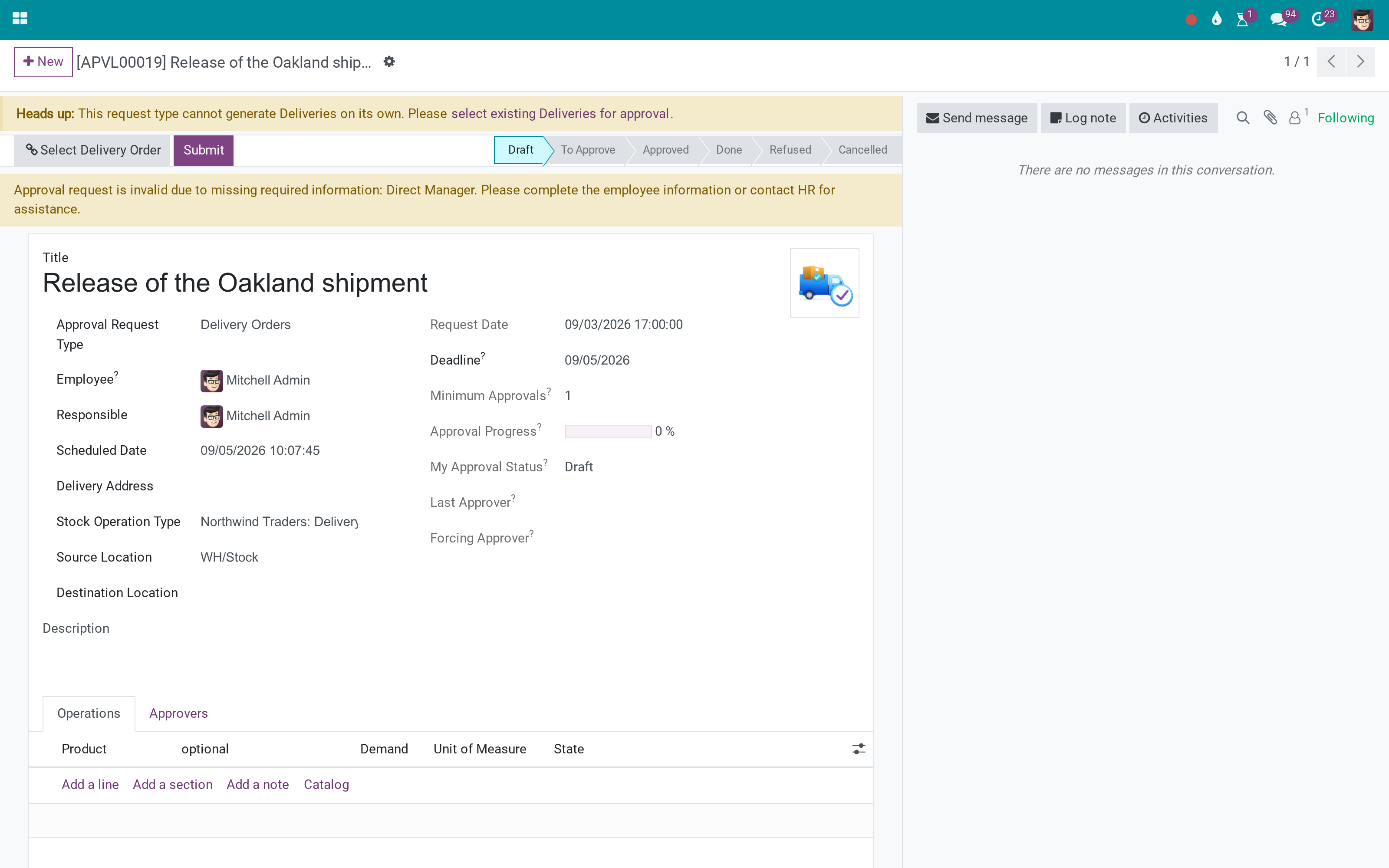
Operation type, source and destination warehouse and location on the approval request - so a transfer approval carries where the goods are going.
OmniApproval™ - Stock Approvals (technical name viin_approval_stock) is an Odoo 19.0 app for Odoo Community and Odoo Enterprise and Viindoo Cloud, built for warehouse manager, approver, finance, administrator.
At a Glance
The facts of OmniApproval™ - Stock Approvals, version 0.1.3, in one place. Published by Viindoo.
How It Works
Three screens.
The request carries the movement
Operation type, source location and what is being released.
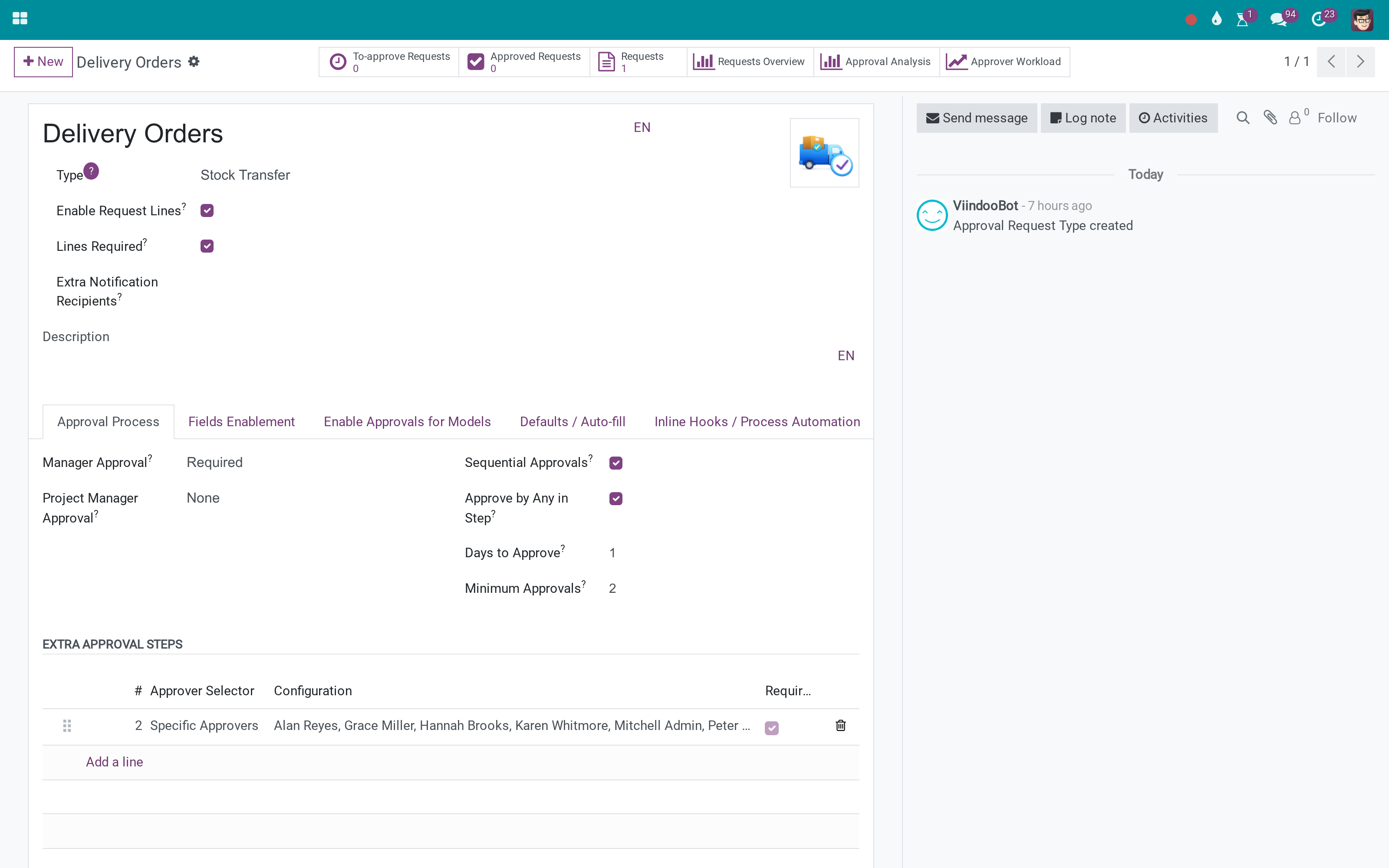
Configured per type
Approvers, rules, and which inventory fields the request carries.
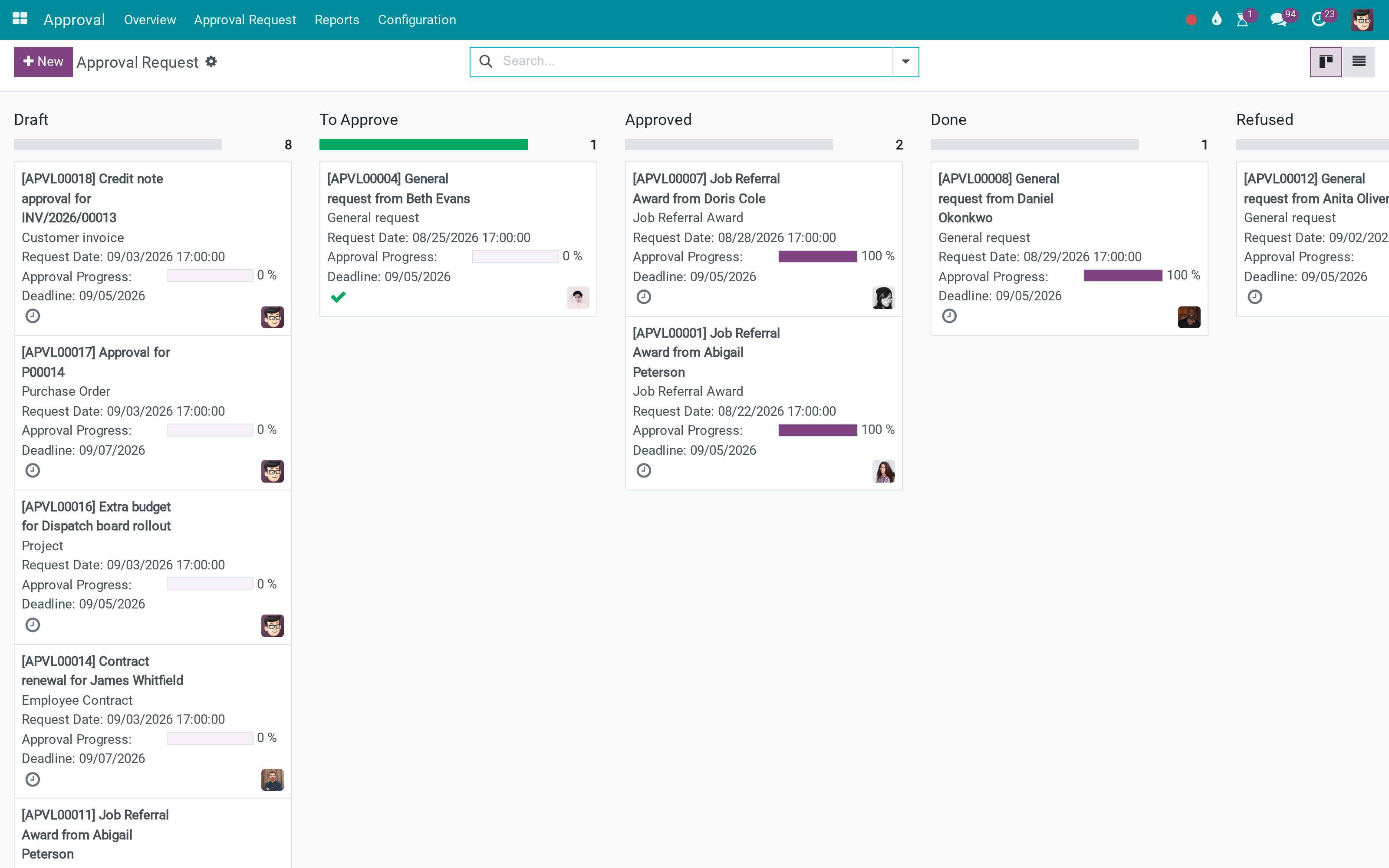
In the same queue
Stock approvals sit with purchases, contracts and the rest.
What You Get
Operation type on the approval request
Source and destination warehouse and location
The transfers and stock moves the request is about
Field toggles per approval type, on header and lines
Sequential approvers, minimum approvals and deadlines from the engine
Warehouse operations otherwise unchanged
More Screens
Everything below was taken on a database seeded with real business data, on this series - not a mock-up and not a screenshot from an older version.
Field toggles per type
What This App Does Not Do
Read this before you buy. Everything below is something the app deliberately leaves to another app or to you.
Blocking is the approval state applied to the document by the engine.
Inventory logic stays Odoo's.
This is the inventory bridge to that engine.
Which types do is configuration - deliberately.
Works Well With
Apps from the same stack, built to fit this one:
Who Should Use OmniApproval™ - Stock Approvals?
Warehouse manager
Releases a shipment against an approval, not a phone call.
Approver
Sees the operation, the source and the destination.
Finance
Can require a signature before high-value stock leaves.
Administrator
Configures per operation type what must be approved.
Frequently Asked Questions
What does OmniApproval™ - Stock Approvals do?
Operation type, source and destination warehouse and location on the approval request - so a transfer approval carries where the goods are going.
What does OmniApproval™ - Stock Approvals not do?
It does not block validation by itself. Blocking is the approval state applied to the document by the engine. It does not reserve or unreserve stock. Inventory logic stays Odoo's. It needs OmniApproval. This is the inventory bridge to that engine. Not every transfer should need approval. Which types do is configuration - deliberately.
Who is OmniApproval™ - Stock Approvals for?
Warehouse manager: Releases a shipment against an approval, not a phone call. Approver: Sees the operation, the source and the destination. Finance: Can require a signature before high-value stock leaves. Administrator: Configures per operation type what must be approved.
Which Odoo version and editions does it support?
Odoo 19.0 - Odoo Community, Odoo Enterprise, Viindoo Cloud. Upgrades to a newer Odoo series are a separate purchase for that series.
What does it depend on?
It installs on top of: viin_approval, stock. Odoo installs them with it.
How do I set it up?
Three screens.
What works well with it?
OmniApproval (viin_approval): The engine this extends.Warehouse Access Control (to_multi_warehouse_access_control): Who may operate which warehouse at all.
Can I try it before buying?
Yes - the Live Preview button at the top of this page opens a working database.
How do I get support?
Write to apps.support@viindoo.com with your Odoo version and the technical name viin_approval_stock; pre-sales questions go to sales@viindoo.com.
See OmniApproval™ - Stock Approvals in Action
Live demo: v19demo-int.viindoo.com
Need help with OmniApproval™ - Stock Approvals?
For questions, implementation support or a custom feature, contact Viindoo.
Pre-Sales & Partnership
sales@viindoo.comUpgrades to a newer Odoo series are a separate purchase for that series.
All Viindoo apps: Viindoo Apps
Technical Requirement
Changes log
0.1.2 - Latest on the 17.0 line
- Source and destination warehouses are available alongside locations.
OmniApproval™ - Stock Approvals
For inventory users, warehouse managers, approvers and approval administrators.
Note
Extends OmniApproval™ - see its documentation for roles, approvers, snapshots and every other engine feature. This guide only describes what the Delivery Orders and Inventory Reallocation approval types add.
Note
Extends Inventory. For the supply flow of procurement requests, see the guide of OmniApproval™ - Procurement Approvals.
Overview
Goods should leave the warehouse, or move between warehouses, only after the right people have agreed. The module adds two approval types to every company:
- Delivery Orders - a delivery order is approved before it is confirmed.
- Inventory Reallocation - a stock move from one warehouse to another is approved, and its transfers are created from the approved request.
| Role | What they do | Access right to assign |
|---|---|---|
| Inventory user | Prepares the delivery order or the reallocation, submits it for approval and follows the transfers it generates. | Inventory: User |
| Warehouse manager | Follows the transfers of the warehouse. Holding the Inventory Administrator right alone gives no approval role. | Inventory: Administrator |
| Approver | Decides on the requests that reach them. | Team Approver or Officer |
| Approval administrator | Adjusts the Delivery Orders and Inventory Reallocation types. | Administrator (Approvals) |
The Team Approver, Officer and Administrator rights are described in the Roles and Access Rights section of the OmniApproval™ guide.
Setup (for the Administrator)
- Go to Apps, search for OmniApproval™ - Stock Approvals and click Activate.
- Open Approval > Configuration > Approval Types. Each company now has an approval type named Delivery Orders and one named Inventory Reallocation, ready to use.
- Give each person the access right of their role under Settings > Users & Companies > Users.
Both types ask the employee's manager for the first approval step and name no approver. Who approves, and in how many steps, is yours to decide: add approvers to the type as described in the Approvers section of the OmniApproval™ guide.
What the Delivery Orders type adds
Only delivery orders still in Draft, Waiting, Waiting Another Operation or Ready can be submitted for approval. Each delivery order becomes one request.
The request is filled in from the delivery order:
| On the delivery order | On the request |
|---|---|
| Scheduled date | Scheduled Date |
| Delivery address, operation type, responsible and company | Delivery Address, Stock Operation Type, Responsible and Company |
| Source and destination locations | Source Location and Destination Location |
| Deadline and procurement group | The same fields of the request; they only travel from the delivery order to the request |
| Each operation: product, unit of measure, demand, locations, scheduled date, description | The same columns of the request lines, listed under Operations; the demand is shown as Demand |
The scheduled date of the operations still travels to the request lines, but it is not part of the comparison described in the Snapshots and Diff section of the OmniApproval™ guide: validating a delivery order moves that date, and that is not a change to what was approved.
Using the Delivery Orders approval
Submitting a delivery order (Inventory user)
Delivery order approvals always start from the delivery order itself: the Delivery Orders type does not create delivery orders of its own.
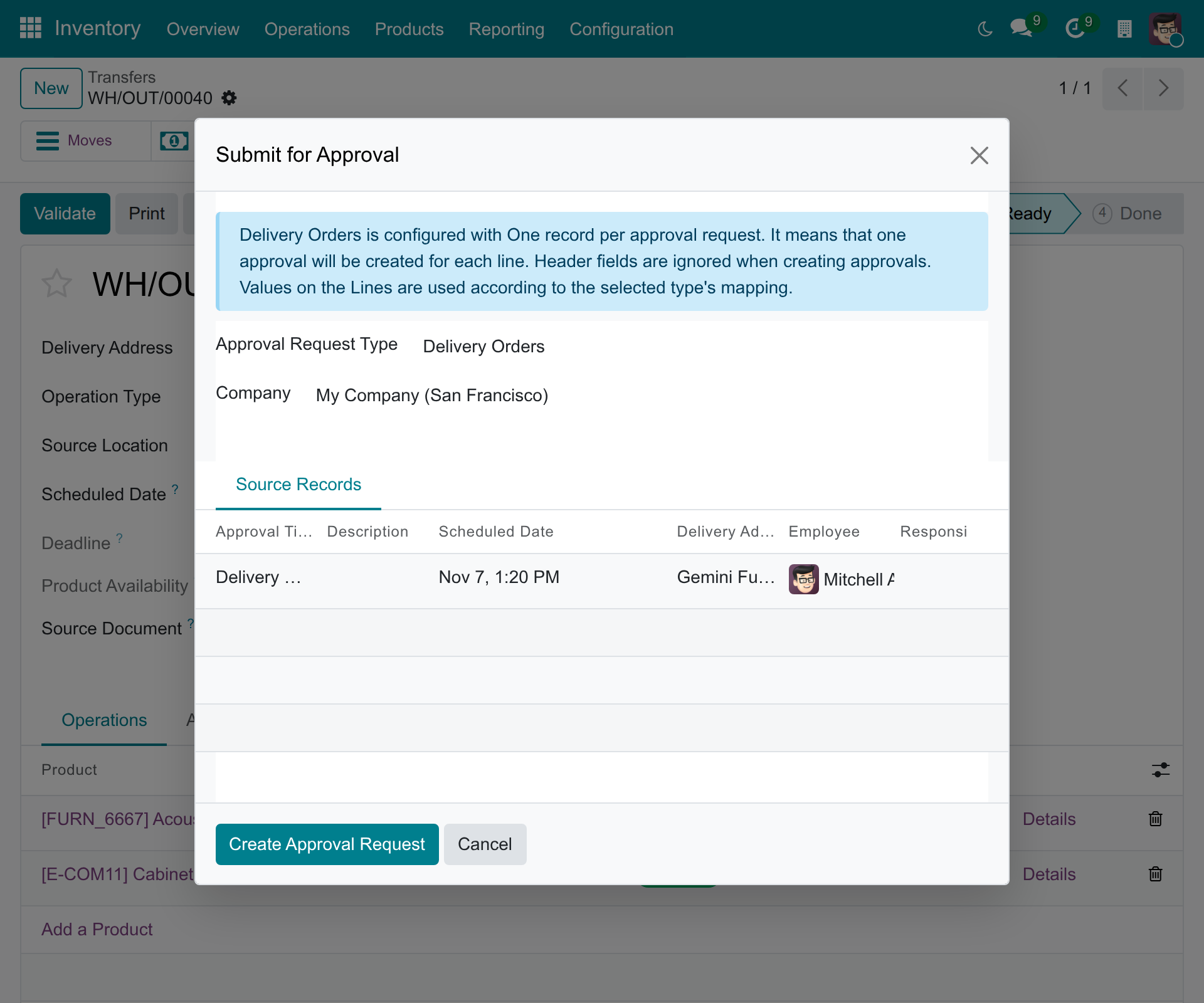
- Open the delivery order and click Actions (the gear icon next to its name) > Get Approved.
- Check the approval type and the delivery order shown in the Submit for Approval window.
- Click Create Approval Request.
The request opens in Draft, with the operations of the delivery order under Operations.
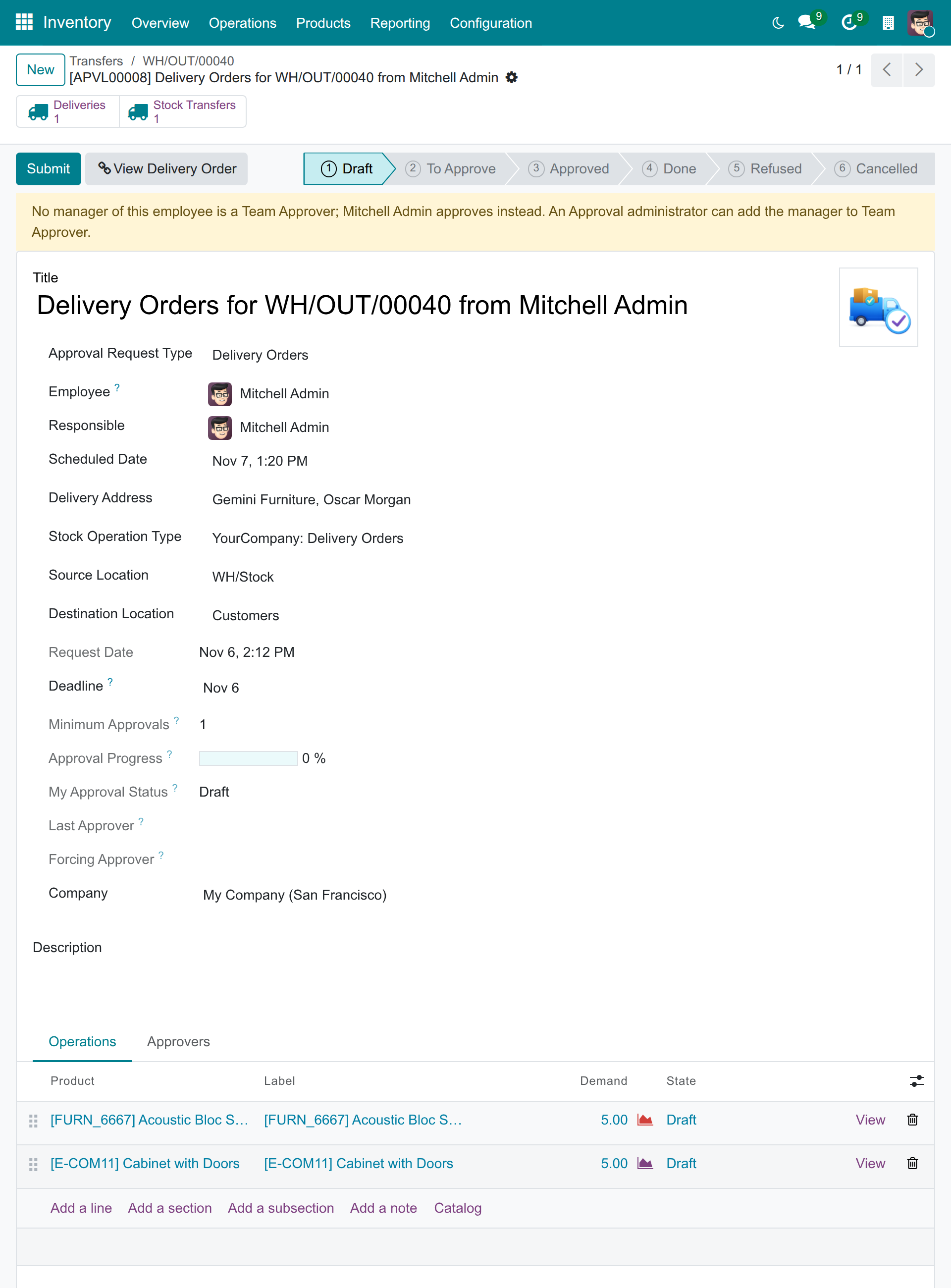
Click Submit to send it to the approvers. Approving, refusing and the other decisions work as described in the OmniApproval™ guide.
Validating the approved delivery order (Inventory user)
Once the request is approved, the delivery order is confirmed and you process it as usual until its Validate button. Validating the delivery order is not a change to what was approved: the request records no note.
Approval never blocks Validate by itself. See the Business Documents section of the OmniApproval™ guide to add a block.
Changes made after submission
If someone edits an operation of the delivery order after the request was submitted - for example its demand - the request shows a warning and its chatter notes the change once, with the difference. Nothing is blocked and nobody has to approve again.
Inventory Reallocation
An inventory reallocation request lists, on the Reallocation Lines tab, the products to move with their Source Warehouse, Destination Warehouse, Quantity and, optionally, the Routes to follow (the Routes column appears when Multi-Step Routes is enabled in the Inventory settings). Create it from Approval > Overview: find the Inventory Reallocation card and click Create Request, fill in the Scheduled Date and the lines, then click Submit. The source and destination warehouse of a line must be different.
When the request is approved, the system launches its procurement by itself, once: the transfers between the warehouses are generated from the routes of the lines, along a multi-step resupply chain as well. The References smart button of the request then opens the stock references that were generated, and the Receipts, Deliveries and Stock Transfers buttons open the transfers (they are visible to users with the Inventory User right).
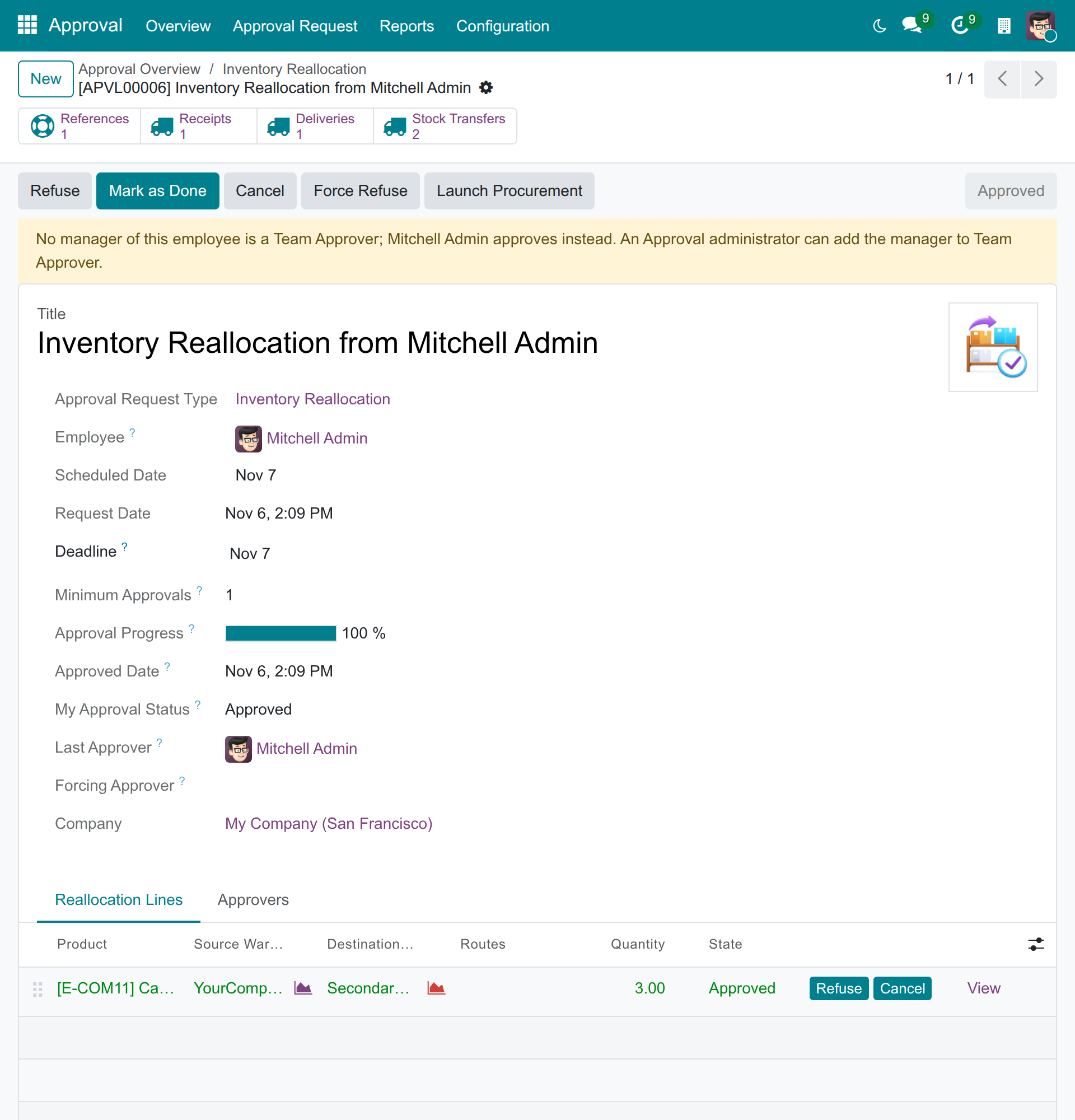
Launching the procurement again (Inventory user)
While the request is Approved, the Launch Procurement button stays in the header. Pressing it never duplicates what was already generated: only the lines whose procurement was not launched yet are launched. When every line has already been launched, nothing more is generated and the message The procurement of the request ... was already launched for all its lines. is shown. Only users with the Inventory User right can press the button.
The same button and behaviour apply to procurement requests; see the guide of OmniApproval™ - Procurement Approvals for that flow.
Cancelling or refusing a request
When an approved inventory reallocation request is cancelled or refused, every transfer it generated is removed, along a multi-step resupply chain as well: a receipt and the delivery that feeds it disappear together. A transfer or a stock reference that existed before the request is left as it is, and so is a delivery order that a Delivery Orders request was raised from.
A transfer that is already Done blocks the cancellation or the refusal. The message names the transfer and the way out:
- Open the transfer in Inventory and click Return to give its goods back.
- The request stays Approved. Click Mark as Done on the request to close it.
The message reads: The approval request ... cannot be cancelled or refused: ... is already done and a done transfer cannot be cancelled. A Return of it in Inventory gives its goods back, but the request stays approved: close it with Mark as Done.
This software and associated files (the "Software") may only be used (executed, modified, executed after modifications) if you have purchased a valid license from the authors, typically via Odoo Apps, or if you have received a written agreement from the authors of the Software (see the COPYRIGHT file).
You may develop Odoo modules that use the Software as a library (typically by depending on it, importing it and using its resources), but without copying any source code or material from the Software. You may distribute those modules under the license of your choice, provided that this license is compatible with the terms of the Odoo Proprietary License (For example: LGPL, MIT, or proprietary licenses similar to this one).
It is forbidden to publish, distribute, sublicense, or sell copies of the Software or modified copies of the Software.
The above copyright notice and this permission notice must be included in all copies or substantial portions of the Software.
THE SOFTWARE IS PROVIDED "AS IS", WITHOUT WARRANTY OF ANY KIND, EXPRESS OR IMPLIED, INCLUDING BUT NOT LIMITED TO THE WARRANTIES OF MERCHANTABILITY, FITNESS FOR A PARTICULAR PURPOSE AND NONINFRINGEMENT. IN NO EVENT SHALL THE AUTHORS OR COPYRIGHT HOLDERS BE LIABLE FOR ANY CLAIM, DAMAGES OR OTHER LIABILITY, WHETHER IN AN ACTION OF CONTRACT, TORT OR OTHERWISE, ARISING FROM, OUT OF OR IN CONNECTION WITH THE SOFTWARE OR THE USE OR OTHER DEALINGS IN THE SOFTWARE.